
Introduction
The July 1, 2026 launch of the USMCA Joint Review has triggered headlines suggesting uncertainty in North American trade. Much of the attention has focused on the United States declining to extend the agreement “in its current form.”
However, the underlying reality is far more stable – and far more relevant for industrial stakeholders. The agreement remains fully operational, negotiations are ongoing, and economic interdependence across North America continues to anchor policy decisions.
For manufacturers, EPC firms, and developers working across energy infrastructure, transmission facilities, and industrial projects, the most probable outcome is not disruption – but measured evolution.
Understanding the USMCA Review Process
Unlike traditional trade agreements, USMCA includes a built-in mechanism designed to balance long-term certainty with periodic modernization.
Key elements of the review process include:
- A mandatory joint review every six years
- A decision point on whether to extend the agreement for 16 additional years
- If no agreement is reached, annual review cycles continue
- The agreement remains active until its scheduled sunset date in 2036
For a detailed explanation of the framework, see the official USTR statement on the 2026 Joint Review.
Key takeaway:
The review is designed to prevent disruption, not create it. It allows modification without undermining cross-border trade continuity.
Current Status: Negotiations Without Disruption
Following the July 1 review, the United States indicated it would not extend the agreement “as currently structured.” This triggered concern – but the full statement clarified several critical points:
- USMCA remains in force
- Negotiations with Canada and Mexico are continuing
- Additional discussions are already scheduled
- The goal is revision, not withdrawal
This distinction matters for capital-intensive industries such as:
- Natural gas processing plant development
- Carbon capture and CO₂ pipeline infrastructure
- Industrial manufacturing and fabrication
Projects involving long development timelines depend on regulatory stability – and the review mechanism supports exactly that.
USMCA Review Timeline
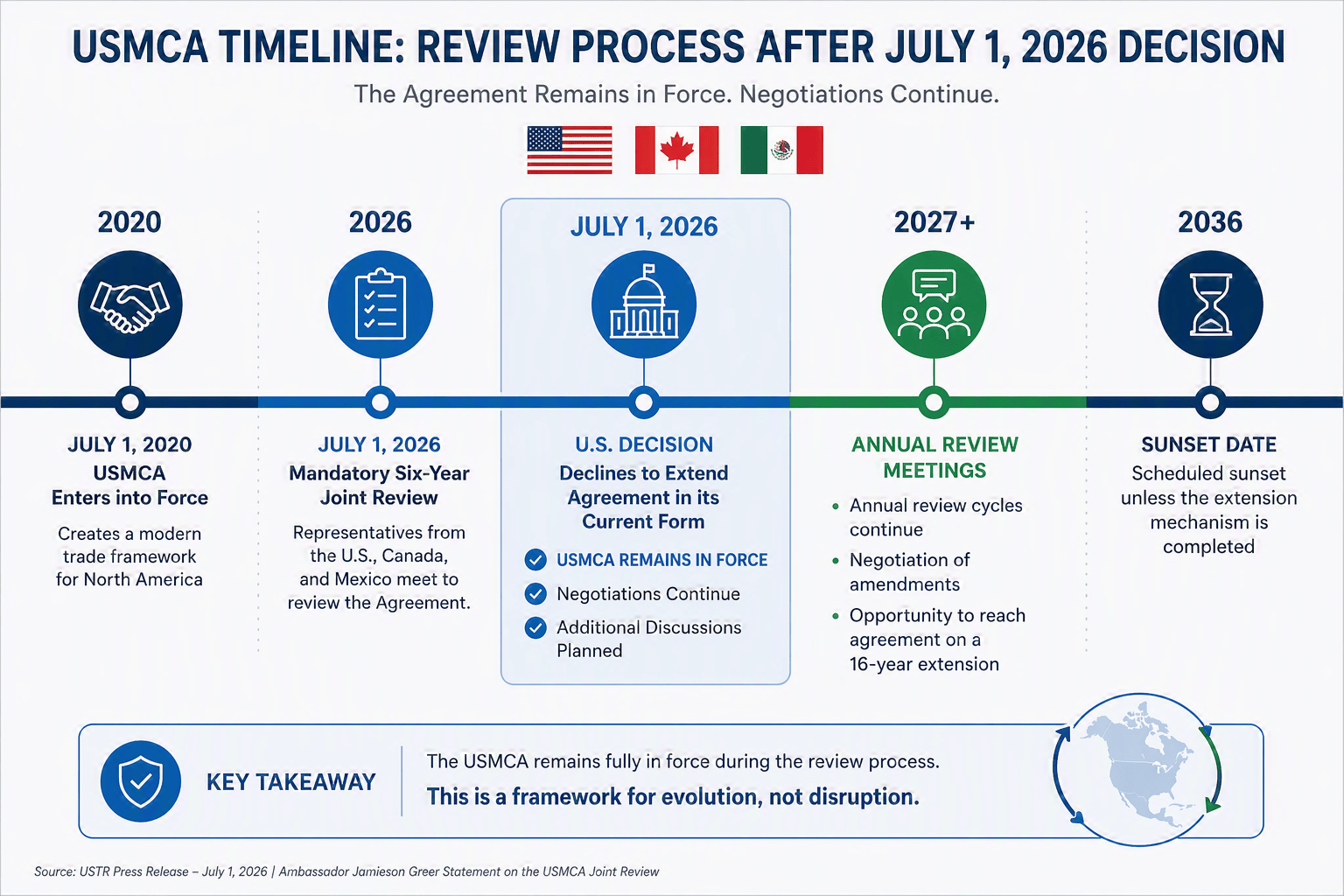
Bottom line: The agreement continues functioning while negotiations evolve.
Why This Matters for Industrial Development
North America operates as one of the most integrated economic ecosystems in the world. Supply chains in the following sectors are deeply interconnected:
- Automotive and heavy manufacturing
- Energy and pipeline infrastructure
- Chemicals and gas processing
- Agriculture
Research from the Rice University Baker Institute highlights that this level of integration makes major structural disruption unlikely.
For engineering firms and developers, this reinforces confidence in:
- Capital project planning
- Cross-border procurement strategies
- Modularization and fabrication approaches
- Total installed cost optimization
Automotive Rules and Regional Content
One of the most closely watched areas of negotiation is rules of origin, particularly in the automotive sector.
USMCA already increased regional content thresholds significantly compared to NAFTA. Potential updates may include:
- Higher North American content requirements
- Tighter compliance and verification
- Expanded tracking of upstream supply chains
These changes align with broader policy goals:
- Expanding domestic manufacturing capacity
- Strengthening supply chain resilience
- Supporting long-term industrial competitiveness
For developers of cryogenic gas processing, NGL fractionation, and manufacturing systems, this could influence equipment sourcing and fabrication strategies.
Interested in moving equipment across the border? CANUSA EPC has experience with bringing equipment in both directions.
China’s Role in the Background
While China is not part of USMCA, it remains a central consideration in the review.
Key concerns include:
- Chinese-owned subsidiaries operating within North America
- Use of Chinese components in regional manufacturing
- Potential tariff circumvention
- Strategic industrial security
The Baker Institute notes that future provisions may aim to:
- Limit indirect access to USMCA benefits
- Increase transparency in supply chain origin
- Protect critical infrastructure sectors
This has implications for:
- Battery manufacturing and electrification systems
- Electronic components
- Advanced industrial equipment supply chains
What Businesses Should Monitor
For firms involved in engineering, procurement, and construction, several focus areas stand out:
- North American Content Requirements
Changes could impact:
- Supplier qualification
- Modular fabrication locations
- Procurement strategies
- China-Linked Supply Chains
Expect:
- Increased scrutiny
- Additional compliance documentation
- Potential sourcing shifts
- Strategic Manufacturing Investment
Governments are prioritizing:
- Domestic production
- Critical infrastructure
- Industrial resilience
- Long-Term Project Stability
The most important takeaway:
Ongoing negotiations do not equate to project risk.
Large-scale projects – including carbon capture systems, on-site power generation, and gas processing – remain supported by a functioning trade framework.
Conclusion: Evolution, Not Disruption
The 2026 USMCA Review is not a referendum on North American trade – it is a mechanism for modernization.
Despite political headlines, the fundamentals remain clear:
- Trade continues uninterrupted
- Negotiations are structured and ongoing
- Economic interdependence limits drastic changes
For industrial developers and EPC leaders, the outlook is stable.
Expect targeted reforms, continued negotiations, and policy adjustments – but not a breakdown of North American trade integration.
Planning a cross-border project or evaluating supply chain risk?
Connect with CANUSA EPC to assess how evolving trade policy impacts your next energy, infrastructure, or industrial development project.
__________
Author(s)
Forrest Churchill